SAP Transformation – Frequently Asked Questions (FAQ)
English | Spanish | Hindi | Punjabi
Last Updated June 29, 2026
(For a full glossary of terms and acronyms, see Appendix A at the bottom.)
Understanding SAP
What is SAP?
SAP is an advanced ERP system that stores and connects key business information, such as finance, purchasing, inventory, projects, and operations, in one place, ensuring everyone works with the same up‑to‑date data.
Why are we moving our systems to SAP?
Today, our business relies on multiple disconnected systems. This lack of integration can lead to delays and data errors. SAP will provide improved accuracy, standardized processes, and real‑time data sharing to support growth.
What happens to the old ERP system?
It will be phased out, and historical data will be stored as needed.
Timeline and Rollout
When will the change happen?
The SAP Transformation is being rolled out in phases. Exact cutover dates will be shared once available.
When does SAP go live?
The first Go-Live is August 6, 2026, at 6:00 AM. This covers Uncle Wally’s and associated operations. SAP is being rolled out in phases across Give & Go – not all at once.
Is everyone going live on August 6?
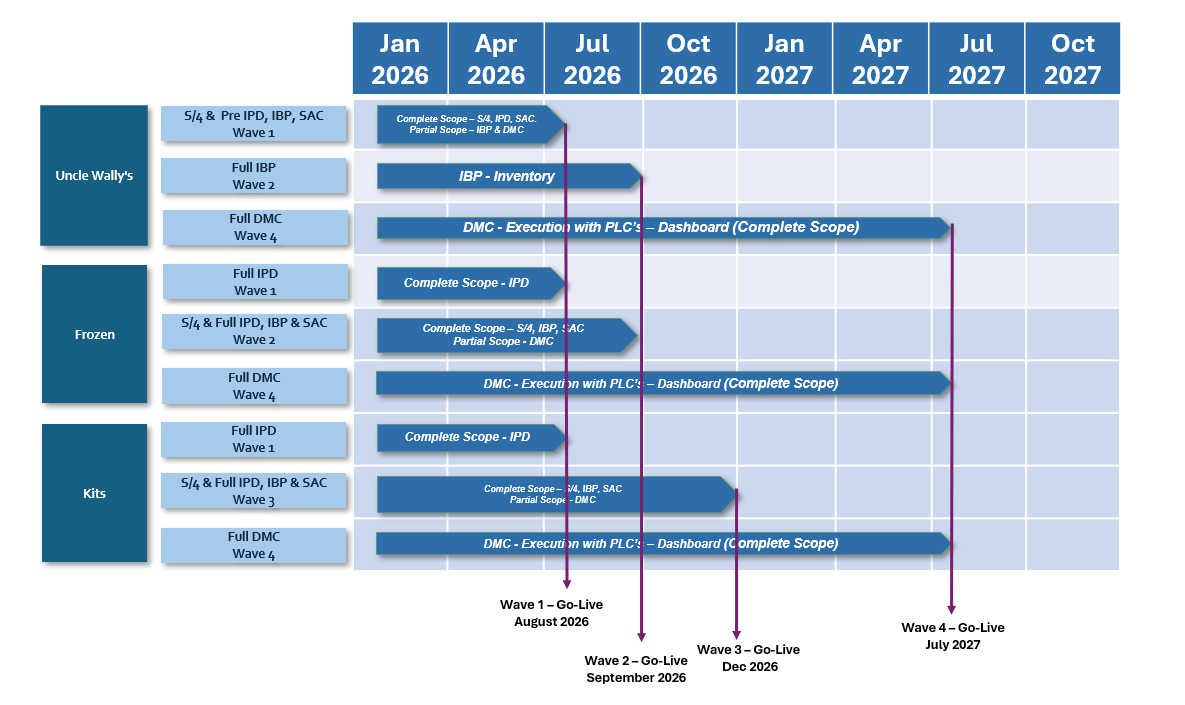
No. August 6 applies to Uncle Wally’s only. SAP is rolling out in phases across Give & Go:
- Wave 1 – Uncle Wally’s: August 6, 2026
- Wave 2 – Frozen: October 2026
- Wave 3 – Kits: December 2026
- Wave 4 – Integrated Product Development (IPD), Integrated Business Planning (IBP), Demand Management and Control (DMC) and all functions: July 2027
If your role does not support Uncle Wally’s today, there are no changes to your work right now. You will receive communication, training, and support well in advance of your wave.
Am I Affected?
How do I know if I am part of Wave 1?
You are part of Wave 1 if:
- Your daily role supports Uncle Wally’s operations – whether you are based at Uncle Wally’s or support those operations from another location.
- You are attending SAP training in June.
- Your manager has spoken to you about Wave 1 or joining training in June.
If you are unsure, ask your manager.
What does Go-Live mean for me if I am in Wave 1?
Starting August 6, you will complete your work in SAP instead of the current tools and systems. Some processes may feel different at first as you get used to new screens and steps. Dedicated support teams, Give & Go subject matter experts, and our implementation partners will be available before, during, and after Go-Live to answer questions and resolve issues quickly. You will not be navigating this alone.
What if I am not part of Wave 1?
There is no action required from you right now. Nothing about your day-to-day work changes on August 6. When your wave approaches, you will receive advance notice, training, and support before any changes impact your role.
How will this change affect my daily work?
Tasks currently done in NAV* and Visual* etc will shift to SAP. Some paper‑based tasks will also move into SAP.
Will we still be able to complete tasks on paper?
Processes required to be completed in SAP will be clearly communicated.
Will SAP slow down production?
There may be an initial learning curve, but SAP is designed to improve efficiency and accuracy long‑term.
What do I need to do to prepare?
If you are in Wave 1:
- Attend your assigned training sessions in June.
- Practice in SAP training environments and review your materials.
- Ask questions – that is what training is for.
- Reach out to your manager or trainer if anything is unclear.
- Check the Project Carmenta site for updates and resources.
If you are not in Wave 1, no action is required from you right now.
Jobs and Roles
Will there be role changes?
Your day‑to‑day may look slightly different, but your essential duties will remain the same.
Will my role change so much that I won’t be qualified?
No. Your responsibilities aren’t changing; SAP simply helps you complete tasks more efficiently.
Will I need new login credentials?
Yes. SAP uses its own dedicated login system.
What if I’m not comfortable with technology?
Training and ongoing support will be provided to ensure you can work confidently in SAP.
Testing
What is System Integration Testing (SIT)?
SIT is the phase where teams test that SAP works correctly before Go-Live. Give & Go has completed one round of SIT (SIT1).
What is SIT2?
SIT2 is the second and deeper round of system testing. In SIT1, teams confirmed that individual parts of SAP were working as expected. SIT2 goes further by testing complete business processes that span multiple departments – helping ensure everything works together the way it should in real operations. SIT2 is also giving representatives from each department hands-on experience with SAP ahead of Go-Live.
What is User Acceptance Testing (UAT)?
UAT begins June 12. This is where we test SAP using the actual tasks and processes from each role’s day-to-day work. The goal is to confirm that SAP supports the way we work specifically at Give & Go, and that we are all comfortable using the system before Go-Live. Think of UAT as the business’s opportunity to confirm SAP is ready.
Who participates in testing?
Functional leads, designated trainers, and subject matter experts from each department participate in SIT2 and UAT. Their job is to test real processes, flag any issues, and help ensure the system works for Give & Go before it goes live.
What happens if an issue is found during testing?
Any issues identified during testing are logged, reviewed, and resolved by the project team and our implementation partners before Go-Live. That is exactly why testing happens – to catch and fix problems before they affect real operations.
Training
What kind of training will I get?
Training may include instructor‑led classes, e‑learning, job aids, and/or on‑the‑job training depending on your role.
How is training being delivered?
We are using a Train-the-Trainer approach. Designated trainers from each department are participating in SIT2 testing, where they are gaining hands-on SAP experience. They will then deliver training and support to their teams ahead of Go-Live. This means you will learn from someone who understands your role, your team’s processes, and how SAP will be used in your day-to-day work.
Why a Train-the-Trainer approach?
This approach means training is more practical, relevant, and relatable. Learning from a familiar colleague who understands your work makes a significant difference compared to a generic training session. It also creates a network of knowledgeable trainers and Super Users who can continue supporting the business before, during, and after Go-Live.
What training will Wave 1 participants receive?
- SAP basic navigation
- Role-based training aligned to your responsibilities
- Hands-on practice in SAP training environments
- Job aids and reference materials
- Support from trainers, Super Users, and the project team
When does training happen?
Training is underway now and will continue throughout June. If you are in Wave 1 and have not yet been informed of your training schedule, speak to your manager.
When will I receive my SAP access credentials?
For Wave 1, you can expect to receive your SAP access credentials on or before August 6. Detailed instructions on how to log in, access the system, and set up your SAP homepage will be provided.
What is a Super User?
Super Users are colleagues from each functional area who have been trained to a deeper level on SAP. After Go-Live, Super Users are the go-to people for hands-on help with SAP transactions, navigation, and process questions. They are your first line of support once the system is live.
Go-Live and Cutover
What is cutover?
Cutover is the period when we switch from our old systems to SAP. At Uncle Wally’s, production and shipping activities will pause on July 31 at 3:00 PM EST while technical and operational cutover activities take place. SAP Go-Live is then scheduled for August 6 at 6:00 AM.
Why is there a pause in operations?
The pause is necessary to safely complete the technical migration – moving data, validating the system, and confirming everything is ready before SAP goes live. This is standard practice in large system implementations and has been planned carefully to minimise business impact.
Will there be downtime?
There may be short periods of downtime during cutover. These will be communicated in advance with business impact considered.
What support will be available at Go-Live?
Dedicated support teams, Give & Go subject matter experts, and our implementation partners will be available before, during, and after Go-Live to answer questions and resolve issues quickly. The goal is to make sure everyone feels supported and that any issues are addressed fast.
Have customers and vendors been told about the transition?
Yes. Customers and vendors have been informed of the transition timeline so that expectations are aligned and the business is prepared for Go-Live.
What is Business Continuity Planning (BCP)?
BCP is the process of preparing for any disruptions that could occur during the transition to SAP. Teams across Give & Go have worked through detailed readiness and contingency plans to support a smooth transition. The focus is on protecting food safety, keeping the business running smoothly, and making sure everyone is supported every step of the way.
Data and Technology Readiness
What is happening with data before Go-Live?
The Data Team is working closely with our implementation partners to load and validate Give & Go data in SAP. This includes vendor records, customer data, material numbers, and historical information. These activities help ensure information is transferred accurately, issues are identified early, and teams have confidence in the data before the final migration takes place.
Why does data quality matter so much?
SAP is only as good as the data in it. If records are incomplete, inaccurate, or missing, it can cause problems with orders, payments, production, and reporting from day one. Getting data right before Go-Live is one of the most critical steps in the whole project.
What is happening with technology at Uncle Wally’s?
At Uncle Wally’s, the IT team is validating devices, connectivity, and system access to make sure everyone can successfully use SAP in their day-to-day work environment. This includes making sure the right people have the right access to the right parts of SAP before August 6.
Who has access to SAP right now?
Participants in Wave 1 – including functional leads, trainers, and testing participants – have access to SAP environments that support testing, learning, and training preparation activities ahead of Go-Live. Broader access for end users will be set up as part of training and cutover preparation.
Support and Feedback
Who do I contact if I need help?
You may reach out to your supervisor, site Change Champions, or the SAP Project Team.
How do I give feedback?
You can provide feedback through your site Change Champion or via the feedback link on the Carmenta site.
Who are Change Champions?
Change Champions are fellow Bakers supporting the transition. A full list is available through the Carmenta site or on local notice boards. You may also identify them wearing a ‘Change Champion’ pin.
Appendix A – Glossary of Terms
BCP
Business Continuity Planning. The process of preparing contingency plans to keep the business running smoothly during and after the transition to SAP.
BOM
Bill of Materials. A structured list of all components, raw materials, and quantities needed to produce a finished product. Central to production planning in SAP.
CIA
Change Impact Assessment. A structured analysis of how SAP changes will affect specific roles, processes, and teams across the business.
Cutover
The period when the business switches from old systems to SAP. During cutover, data is migrated, the system is validated, and operations transition to the new platform.
DMC
Demand Management and Control. The workstream covering demand planning and forecast management within the SAP implementation.
EWM
Extended Warehouse Management. The SAP module that manages advanced warehouse operations including bin management, picking, packing, and real-time inventory tracking.
Go-Live
The date when SAP becomes the active system of record and the business begins working in SAP for real operations.
IBP
Integrated Business Planning. SAP’s planning platform replacing Anaplan for demand planning, forecasting, and supply chain planning.
IPD
Integrated Product Development. The SAP module covering recipe formulation, specification management, and product development processes.
ITS
Information Technology Services. Give & Go’s internal IT team responsible for device setup, system access, and technology readiness.
MDG
Master Data Governance. SAP’s solution for maintaining the quality and consistency of master data such as vendor records, material numbers, and customer data.
MRP
Material Requirements Planning. SAP’s automated planning process that calculates material needs and drives production and purchase orders based on demand and inventory data.
OCM
Organizational Change Management. The structured approach to managing the people side of the SAP transition – communications, training, engagement, and readiness.
P2P
Procure to Pay. The end-to-end business process from raising a purchase request through to paying a supplier. Covers purchasing, goods receipt, and finance.
pMRP
Predictive MRP. An advanced SAP planning tool that proactively flags potential supply shortages before they become problems.
SAC
SAP Analytics Cloud. SAP’s platform for dashboards, financial planning, and business intelligence reporting.
SIT
System Integration Testing. The phase where teams test that individual SAP processes and cross-department workflows work correctly before Go-Live.
SIT2
System Integration Testing. The phase where teams test that individual SAP processes and cross-department workflows work correctly before Go-Live.
SPOC
Single Point of Contact. A designated liaison between the project team and a specific department or site.
Super User
A colleague trained to a deeper level on SAP within their functional area. Super Users provide hands-on support to their teams during and after Go-Live.
UAT
User Acceptance Testing. Testing conducted using real day-to-day tasks to confirm SAP supports the way Give & Go works before Go-Live.
Wave
A phase of the SAP rollout. Give & Go’s implementation is split into four waves, each covering a different part of the business.